Painter's Guides
How to Choose a Paint Color (Denver Painter's Guide, 2026)
How Denver painters pick paint colors for real homes in real light — testing swatches, reading undertones, whole-home color flow, and safe-bet picks.
Two decisions determine whether you'll still love your paint color six months from now. One: anchor your palette to something in the room that isn't changing — the floors, the cabinets, the stone counters, or a large piece of furniture or artwork. The wall color's job is to harmonize with the fixed elements, not fight them. Two: test the actual paint on the actual wall in three different lights before you commit. Every other tip on the internet is downstream of those two moves.
Most color regrets we see on a Denver walkthrough don't come from bad taste — they come from picking a color off a tiny chip under fluorescent store lighting, then being surprised when it reads yellow at noon and gray at night in a real room. This guide walks through how we actually pick colors for clients on interior painting jobs: what to anchor to, how to read undertones, how to test swatches properly, the safe-bet colors we keep coming back to in 2026, and the Denver-specific quirks (strong altitude sun, dry winter air, wildly different light by neighborhood) that shift color choices here versus other markets.
Start from what you can't change
The single biggest mistake on a DIY color pick is starting from a Pinterest photo of someone else's house. That photo was shot under specific lighting, with specific furniture, at a specific time of year — almost none of which matches your room.
Start from the fixed elements in your own space instead:
- Floors. Warm oak, cool gray plank, or dark walnut each push the palette a different direction. Warm wood floors call for warm wall colors; gray floors go either direction but usually read best with cool-to-neutral walls.
- Cabinets or built-ins. If they're staying, they're the anchor. For a cabinet painting job where the cabinets are changing too, pick cabinet color and wall color together as one palette.
- Stone or tile. Granite, quartz, and tile have their own undertones. Hold candidate wall-color chips next to the counter under actual kitchen light before committing.
- Large furniture or art. A big rug, a leather sectional, a piece of artwork on the main wall — these carry enough visual weight to influence the whole room's read.
- Trim color. If you're keeping existing white trim, match the undertone (most builder-grade whites lean slightly warm); if you're repainting trim too, decide trim first, wall color second.
The wall color's job is to support and harmonize with whichever of these are fixed. Pick a color that makes your fixed elements look better, not one that forces them to compete.
Test swatches on the actual wall, not on a fan deck
Colors read 1–2 shades different once they're on a real wall next to real furniture and real light. Every color decision should come down to this two-step test:
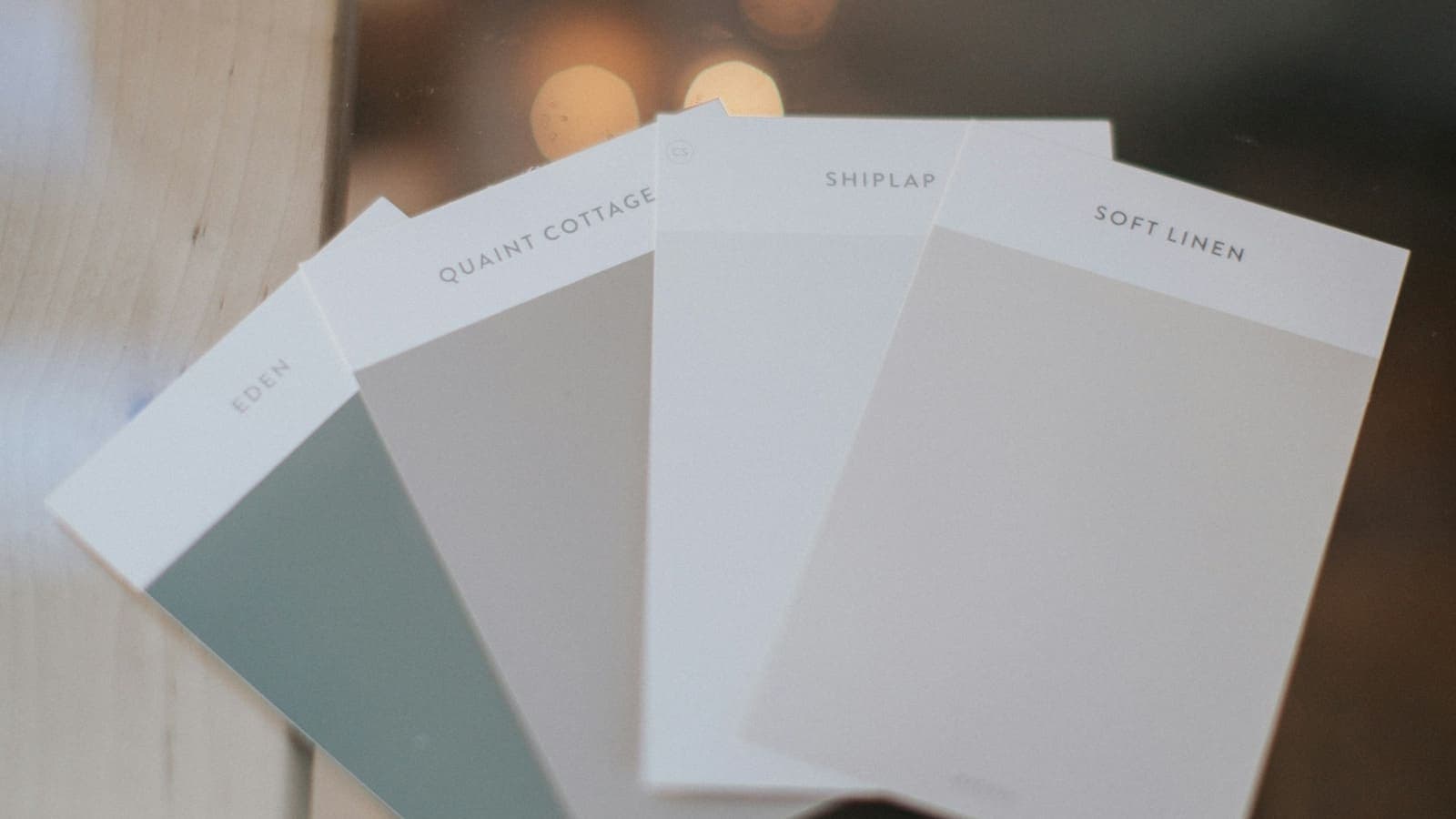
- Narrow to 3–5 candidate chips from a Sherwin-Williams or Benjamin Moore fan deck at the store.
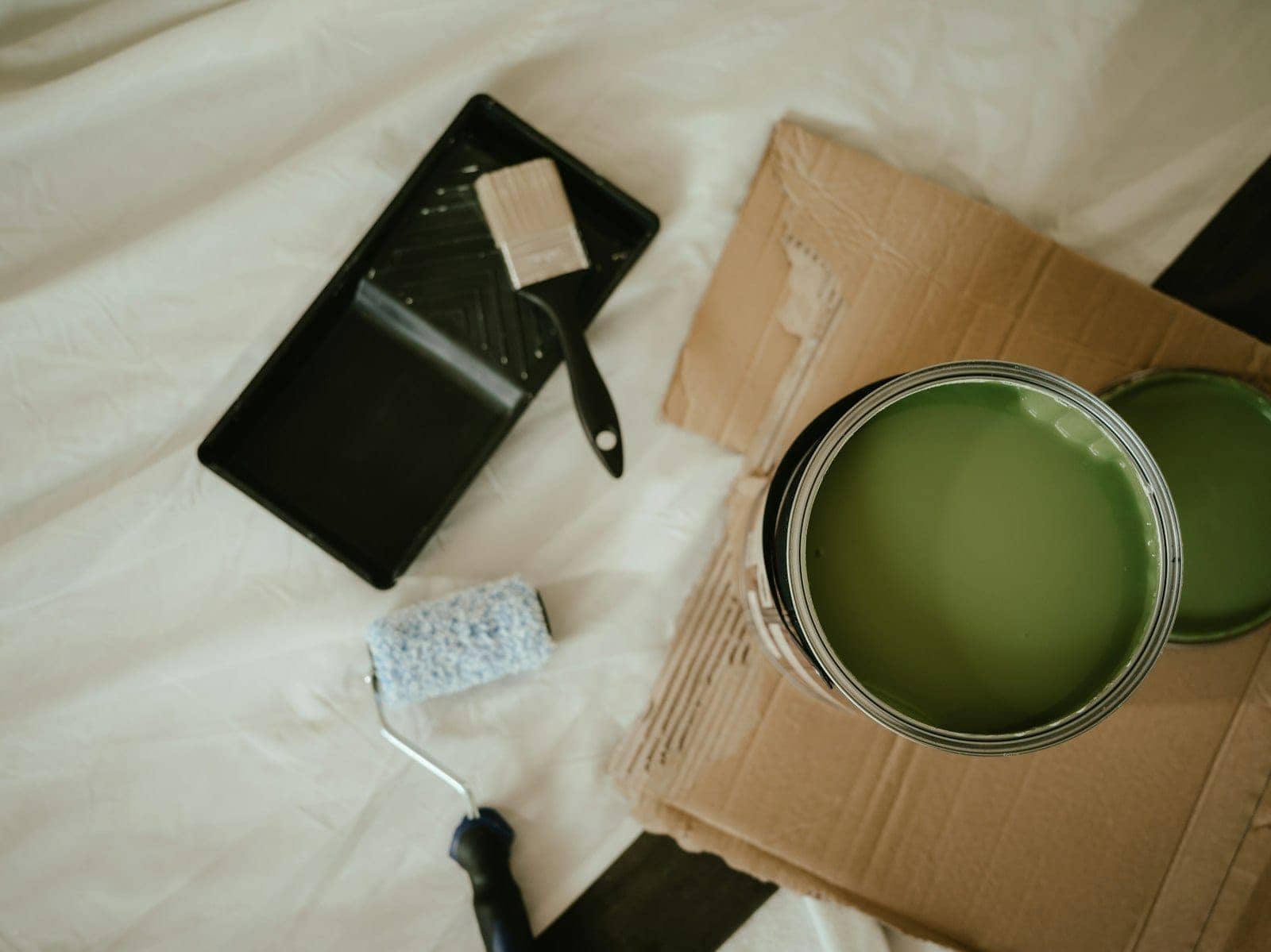
- Buy sample pots (about $10 each) or peel-and-stick Samplize samples (about $7 each) of the finalists, and paint 2×2 ft patches on at least two different walls of the room — one that gets direct window light and one opposite. Leave them up for at least 48 hours.
Never commit to a wall color from the chip alone. The chip shows you the color under fluorescent hardware-store lighting against neutral gray — both of which wildly distort undertones. The wall test shows you the color you're actually going to live with.
Once you've narrowed the 2×2 samples to one or two finalists, paint a larger 4×4 ft patch of each on the wall you're most anxious about. The bigger patch eliminates the small-sample illusion — colors always read slightly lighter or softer on a large area than they do on a chip or a 2-ft test.
Reading undertones
Every neutral paint has an undertone. It's the real reason two beiges that look identical on a chip can look completely different on the wall — one has a warm pink undertone, the other has a cool green undertone, and once they're up, that hidden bias is the whole game.
Warm undertones: yellow, pink, red, peach, gold. Cool undertones: blue, green, gray, violet.
To spot an undertone on any chip, hold it against a sheet of pure-white printer paper. Whatever color the chip looks like next to pure white is its undertone. That soft beige that looked neutral in the store? Against white paper, you suddenly see the pink — or the yellow, or the green — hiding underneath. This trick works on any neutral and takes about three seconds per chip.
Once you know the undertone, the rule is simple: match undertones across the home. Don't put a warm-pink beige in the hallway flowing into a cool-green gray in the living room — your eye will read the transition as wrong even if each color is individually fine. Pick an undertone family (warm or cool) and stick with it through every connected space.
LRV — the one technical spec worth knowing
On the back of every paint chip is a number called LRV (Light Reflectance Value). It runs from 0 (pure black) to 100 (pure white) and tells you how much light the color bounces back. Most homeowners never notice it; it's the spec pros quietly use to settle "is this gray too dark?" arguments.
A quick LRV map:
- Below 25 — reads dark. Deep navy, charcoal, espresso. Dramatic on accent walls, heavy in whole rooms with limited windows.
- 25–55 — reads medium. Most saturated beiges, warm greiges, deeper grays, soft greens and sages.
- 55–75 — reads light. The safest whole-home neutral zone — most of SW's and BM's best-selling beiges and warm grays fall here.
- Above 75 — reads nearly white. Warm whites, soft off-whites, light ceilings.
Denver's strong natural light does two things to LRV that are worth planning around. On south- and west-facing walls, low-LRV (dark) colors read even darker in the morning shadow and wash lighter at noon — if you're debating between two darks, bump up one point for those walls. On north-facing walls that get indirect light all day, the same dark color reads moodier; if the room feels cave-like, move one LRV point higher.
The south- and west-facing wall caveat also matters for fade. Altitude UV fades cheap colorants faster on sunny walls, so any deep or saturated color on a south or west wall should be specified in a premium paint line — see our best paint for interior walls guide for the products we spec.
Whole-home color flow
Picking a color for one room is easy. Picking a palette for a whole home is where most DIY repaints go sideways — usually because people pick one room at a time instead of looking at the whole house as a connected canvas.
The simple, designer-tested framework:
- One trim color, whole house. Usually a warm white — BM White Dove (OC-17) or SW Pure White (SW 7005) cover 90% of Denver homes. The same trim color tying every room together is what makes a house feel cohesive.
- One ceiling color (or default). Flat finish of the trim color is the safe default. A soft modern move: ceiling painted at 50% of the wall color (the paint store mixes it half strength) — this gives ceilings a barely-there glow without dropping them visually.
- Two or three wall colors, same undertone family. One main neutral for the public rooms (living, kitchen, dining), one softer or deeper variant for the primary suite, and optionally a moody accent for a powder bath or office. All three share a warm or cool undertone so the transitions feel intentional.
More than 2–3 wall colors and a home starts reading as chaotic rather than "designer." Less than two and it can feel flat — a good palette has at least one place where the color shifts.
Denver's go-to safe-bet colors, 2026
These are the specific colors we spec most often on Denver interior jobs in 2026. All are in the Sherwin-Williams or Benjamin Moore premium tiers, because for any color — especially deep or saturated ones — product quality matters as much as the color itself.
Living rooms and primary bedrooms
Warm neutrals in matte. Safe, flattering in most light, and unlikely to go out of style fast.
- SW Accessible Beige (SW 7036) — warm greige with a pink-brown undertone; our most-speced neutral in Denver.
- BM Revere Pewter (HC-172) — warm gray with green-brown undertones; the designer classic.
- SW Agreeable Gray (SW 7029) — true greige; slightly cooler than Accessible Beige, still warm enough to work in Denver light.
Kitchens and dining rooms
A touch more saturation or a crisp warm white.
- SW Alabaster (SW 7008) — the warm white. Perfect in kitchens with warm wood floors or warm cabinetry. Fights the "sterile white" feel Denver's dry winter air can give stark whites.
- SW Sea Salt (SW 6204) — soft sage-green; reads gray-green in low light and green-blue in full sun. Currently trending in Denver kitchens and dining rooms.
- Accent islands: deep navy or deep green. BM Hale Navy (HC-154) and SW Naval (SW 6244) are the two navies that read "classic" rather than "trendy" — we use them constantly on island bases paired with warm-white uppers. See our kitchen cabinet cost guide for how cabinet color decisions shake out in full projects.
Bathrooms
Calm cool neutrals or a deep accent.
- SW Repose Gray (SW 7015) — soft warm gray; reads clean and spa-like in most bathroom lighting.
- BM Classic Gray (OC-23) — very light warm gray; good in small powder baths where you want airy rather than dramatic.
- Dark accent route: a deep navy, forest green, or plaster terracotta on one wall — especially in a windowless powder bath where dark color reads as intimate rather than oppressive.
Ceilings and trim
- Trim: BM White Dove (OC-17) or SW Pure White (SW 7005). In semi-gloss. These are the two trim whites Denver pros default to — both warm enough to tie cleanly to any warm neutral on the wall.
- Ceilings: flat finish of the trim color is the default. For modern rooms with lower ceilings or a soft modern look, ceiling at 50% strength of the wall color is the move.
Most popular Denver paint colors, 2026
Big picture, the 2026 direction here is unmistakably warm. The biggest national shift versus the 2018–2022 cool-gray era is the return of warm whites, warm beiges and taupes, soft sage greens, and warm earth tones like terracotta and clay on one or two accent walls. Navy stays in, but often in deeper, moodier takes (Hale Navy over lighter coastal navies). Pure-cool grays are largely on the way out for main rooms; when cool grays appear, they're typically in bathrooms or in homes with intentionally modern, minimalist design language.
Denver-specific color pitfalls
Four quirks of painting in the Denver metro that shift color picks here versus other markets:
- Altitude sun fades cheap colorants fastest on south- and west-facing walls. Any deep or saturated color on a sunny wall should be specified in a premium paint line. Cheap paint in a rich color will shift and fade within 3–4 years on a south wall.
- Dry winter air makes stark whites feel sterile. A pure, crisp white (SW Extra White, BM Chantilly Lace) that reads "modern" in a humid-coast home can read "cold hospital" in a Denver winter. Warm whites are safer.
- South-facing windows bias warm colors warmer. Rooms with big south-facing windows — very common in Denver 1970s-90s builds — will push any warm beige 1–2 steps yellower in summer noon light. Sample in summer if you can; if not, test in the brightest midday window you get and plan for it.
- Foothill-edge and mountain light is cooler and more direct. West-facing foothill-edge homes in Lakewood, south-window-heavy Littleton bungalows, flatland Golden homes, and big-glass mountain homes in Evergreen all read color differently. Foothill and mountain homes tend toward cooler-reading walls even under the same paint — plan on one sample pot more than you think you need in those locations and test on the most-affected wall.
The full color-testing process, step by step
Here's the process we use on interior painting jobs, boiled down for a DIY pick:
- Identify what's fixed. Floors, cabinets, stone, art, trim. The palette has to work with these.
- Pick an undertone family. Warm or cool. Stick with it through every connected room.
- Narrow to 3–5 chips from a fan deck or at the paint store.
- Undertone-check each chip against a sheet of pure-white printer paper. Eliminate the ones whose hidden undertone fights the rest of your palette.
- Check LRV. Anything below 25 on a whole-room wall is a commitment; above 75 is essentially white. Most wall colors should land 40–70.
- Buy sample pots (or Samplize peel-and-sticks) of the 3–5 finalists. Roughly $30–$50 total.
- Paint 2×2 ft patches on two walls per room — ideally one facing a window, one opposite.
- View in three lights over at least 48 hours (morning, noon, evening lamp).
- Narrow to 1–2 finalists and paint a 4×4 ft patch of each.
- Decide. Pick the color you still like on day 3, not day 1.
Total cost: $30–$60 in samples and one weekend. Cheap insurance against a $1,500–$4,000 whole-room repaint.
When to bring in a pro
DIY color picking works fine for a single room repaint in the same family as what's already there. A professional color consultation starts paying for itself in four situations:
- Whole-home repaint. Palette decisions compound across rooms; one mistake early shows up everywhere.
- Dramatic color change. Dark-to-light, cool-to-warm, or any big directional shift needs an experienced eye and the right primer system.
- Hard-to-read spaces. Rooms with bad natural light, odd angles, big built-ins, or unusual ceiling heights.
- Decision fatigue. If you've been circling the same fan deck for three weekends, you're not missing the right color — you're missing a second opinion.
On every quote we write, an on-site color walkthrough is already part of the scope for interior painting. We bring large-format samples, look at them in your actual light, and flag the pitfalls — strong south-window bias, undertone clashes with existing floors, LRV issues on a dark wall — before anyone commits a drop of paint.
Bottom line
The two rules that make every other color decision easier: anchor to what you can't change, and test on the real wall in three lights before you commit. Past that, stick to a single undertone family across the home, keep the palette to 2–3 wall colors, and use premium paint for any saturated or dark color — especially on Denver's sun-soaked south and west walls.
When you want help picking the right palette for your specific home — or just a second opinion on the two finalists you've been going back and forth on — we'll walk the rooms with you, bring real samples, and send an itemized interior painting quote within one business day. Get a free quote here. Already picked the color and just need to pick the product? Our best paint for interior walls guide is the natural next step.
Related services